
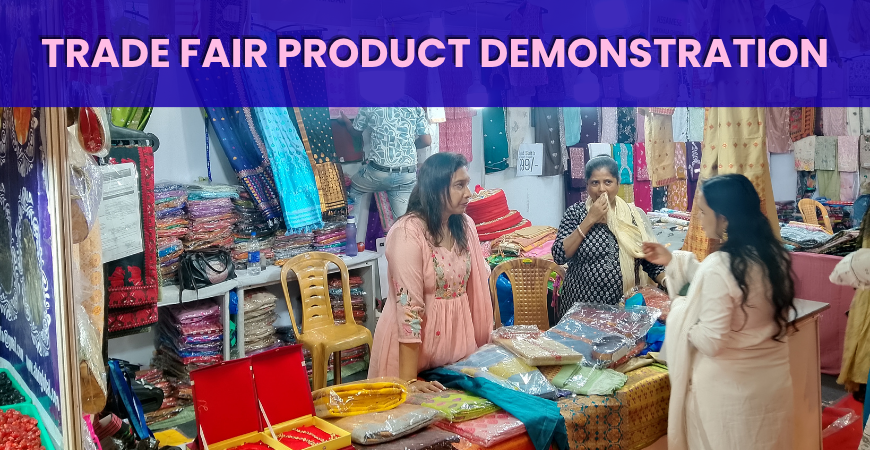
A successful trade fair product demonstration helps visitors understand what a product does, how it works, and why it may be useful to them. Instead of simply displaying products on a table or booth, exhibitors can demonstrate their features in action, answer questions, and give potential customers a clearer idea of what they are considering.
At events such as the India Global Grand Trade Fair, product demonstrations can be a useful way for participating businesses to present their offerings to visitors. The key is to make every demonstration simple, relevant, and engaging without overwhelming people with technical details or lengthy sales pitches.
Why Is Product Demonstration Important at a Trade Fair?
A product display can attract attention, but visitors may not immediately understand how an unfamiliar product works or why they should consider it. A live demonstration bridges that gap by turning product information into a practical experience.
Here are some important benefits:
- Improves understanding: Visitors can see how a product works instead of relying only on descriptions or photographs.
- Makes benefits clearer: Demonstrators can connect individual features with practical uses.
- Encourages questions: Visitors can ask about performance, compatibility, materials, maintenance, or other relevant details.
- Builds confidence: A clear and honest demonstration gives visitors more information to evaluate before making a decision.
- Creates interaction: A demonstration gives people a reason to stop, watch, ask questions, and engage with the exhibitor.
A well-planned demonstration should support the visitor’s decision-making process rather than pressure them into buying immediately.
How to Prepare for a Trade Fair Product Demonstration
Preparation helps prevent awkward delays and ensures that visitors see the product at its best.
1. Set a Clear Demonstration Objective
Start by deciding what you want visitors to understand by the end of the demonstration. Are you introducing a new product, explaining a particular feature, showing how a problem can be solved, or comparing different options?
Choose one main objective for each demonstration. Trying to explain every feature at once can make the presentation difficult to follow.
2. Understand Your Target Visitors
Think about who is likely to attend the event. Individual consumers, retailers, distributors, and business buyers may have different questions and priorities.
For example, a consumer may want to know whether a product is easy to use, while a retailer may be more interested in product variations, supply arrangements, or pricing terms. Understanding these differences helps you prepare a more relevant explanation.
This preparation should be part of your broader trade fair strategy, so the demonstration supports your overall objectives for participating in the event.
3. Choose the Most Relevant Product Features
Select two or three features that best explain the product’s value. Focus on what visitors need to see rather than listing every specification.
If you are demonstrating a kitchen appliance, for example, showing how it performs a common task may be more useful than reading out its technical specifications. For a software product, walking through a practical workflow may explain its usefulness more effectively than displaying a long list of functions.
4. Prepare and Test the Product
Test everything before the event opens. Depending on the product, this may include checking the power supply, internet connection, batteries, moving parts, samples, presentation screens, and safety equipment.
Keep backup materials ready where practical. If a live demonstration depends on a reliable internet connection, for instance, prepare screenshots or a recorded walkthrough that can explain the process if connectivity fails.
5. Plan a Short, Clear Sequence
A simple structure makes demonstrations easier to follow:
- Introduce the problem or need.
- Explain what the product does.
- Show the product in action.
- Highlight the main practical benefit.
- Invite questions and explain the next step.
Practise this sequence before the event. You should be able to deliver the main explanation naturally without reading a script word for word.
7 Trade Fair Product Demonstration Tips to Impress Visitors
1. Start With a Problem Visitors Recognise
Open with a situation your intended audience can relate to. This gives visitors a reason to pay attention.
For example, instead of beginning with a list of technical features, explain the everyday challenge that the product is designed to address. Then demonstrate how it works in that situation.
The goal is to make the product relevant from the beginning.
2. Show the Product in Action
Whenever possible, let the product demonstrate its own usefulness. Show the actual process, feature, or result that visitors need to understand.
If you are showcasing a physical product, make sure people can see the important steps clearly. If you are presenting software or a digital service, use a straightforward example that follows a realistic workflow.
Avoid making claims that the demonstration cannot support. Showing what a product genuinely does is more convincing than relying on exaggerated promises.
3. Focus on Benefits, Not Just Features
A feature describes what a product has or does. A benefit explains why that feature matters to the user.
Consider this simple comparison:
| Feature-focused explanation | Benefit-focused explanation |
|---|---|
| “This device has an adjustable setting.” | “You can adjust the setting to suit different tasks.” |
| “The software includes automated reports.” | “You can generate reports without preparing every section manually.” |
| “This product uses a compact design.” | “Its compact design may help when working with limited space.” |
The benefit-focused version connects product details to a practical need. Make sure each benefit accurately reflects the product’s actual capabilities.
4. Keep the Demonstration Short and Focused
Trade fair visitors often want to explore multiple stalls, so a long presentation may cause them to lose interest.
Keep the main demonstration concise and offer additional details to people who want them. If a product is complex, divide the presentation into short stages rather than trying to explain everything in one session.
A repeatable demonstration also makes it easier for different team members to deliver a consistent explanation throughout the event.
5. Encourage Appropriate Visitor Participation
Interaction can help visitors understand a product more clearly. Depending on the product, you might invite them to handle a sample, try a basic function, test an adjustable feature, or follow a guided activity.
Participation should always be safe, practical, and voluntary. For products that require specialised handling, explain the process first and let trained staff supervise the demonstration.
Not every product needs a hands-on experience. A clear visual presentation may be more suitable for delicate equipment, complex machinery, or products that cannot be handled safely by visitors.
6. Answer Questions Honestly
Questions are an opportunity to understand what visitors care about. Listen carefully and respond directly rather than returning to a prepared sales pitch.
Be ready to explain relevant details such as:
- Product specifications and available variations
- Compatibility or installation requirements
- Maintenance and operating instructions
- Warranty or after-sales conditions, where applicable
- Limitations and situations where the product may not be suitable
If you do not know an answer, say that you will confirm the information rather than guessing. Accurate answers help establish trust.
7. Adapt the Presentation to Different Visitors
Avoid delivering exactly the same explanation to every person. Once you understand a visitor’s needs, emphasise the product details most relevant to them.
A first-time user may appreciate a basic walkthrough, while an experienced buyer may prefer to discuss specifications or product comparisons. A potential distributor may need a different conversation from someone considering a single purchase.
This does not mean changing the facts. It means presenting the most relevant information in a way each visitor can understand.
How to Make a Product Demonstration More Engaging
Beyond the demonstration itself, small presentation choices can make the experience easier to follow.
- Use real-world examples: Show how the product might be used in a familiar situation.
- Make the display easy to see: Arrange products and demonstration materials so visitors can follow the important steps.
- Use supporting visuals: Diagrams, samples, or screens can clarify details that are difficult to demonstrate live.
- Invite focused questions: Ask whether visitors would like to see a particular feature instead of relying on a lengthy monologue.
- Keep the area organised: Remove unnecessary materials that obstruct the demonstration or distract from the product.
- Repeat key demonstrations: If visitor traffic allows, schedule short sessions so people arriving at different times can see the product in action.
These techniques can complement your trade show booth presentation. The booth attracts attention and provides the setting, while the demonstration explains the product’s value.
Common Trade Fair Product Demonstration Mistakes to Avoid
Even a useful product can be difficult to appreciate if the demonstration is poorly planned.
Explaining too many features: Trying to cover everything can confuse visitors. Focus on the most relevant features first.
Using too much technical language: Explain unfamiliar terms in everyday language, especially when speaking to beginners.
Skipping equipment checks: A failed connection, missing component, or uncharged device can interrupt the demonstration. Test everything in advance.
Making unsupported claims: Do not promise results, performance, or benefits that cannot be verified.
Ignoring visitor questions: Questions reveal what people need to know. Address them before continuing with additional features.
Creating unnecessary waiting time: Make the main demonstration accessible to visitors who have only a short time to spare.
Ending without a useful next step: Visitors who want more information should know how to obtain it, whether through a product sheet, a detailed discussion, or another appropriate contact method.
How to Handle Visitor Questions After a Demonstration
The conversation after a demonstration can be as useful as the presentation itself. Start by asking whether the visitor has a particular requirement or would like more information about a feature.
Then:
- Clarify the visitor’s needs.
- Answer relevant product questions.
- Share accurate supporting information.
- Explain suitable options or limitations.
- Agree on a next step if the visitor wants to continue.
If a visitor expresses genuine interest, record the relevant details with their permission. A structured trade show leads process can help exhibitors organise enquiries and distinguish between people who want general information and those who have a specific requirement.
Not every visitor will be ready to buy immediately. The aim is to provide useful information and make it easy for interested people to continue the conversation.
How to Measure the Effectiveness of a Product Demonstration
A busy demonstration area may look successful, but visitor numbers alone do not show whether people understood the product or developed meaningful interest.
Consider tracking these indicators:
| Measure | What it helps you understand |
|---|---|
| Demonstrations completed | How many presentations the team delivered |
| Visitor questions | Which features or concerns attracted attention |
| Requests for more information | Whether visitors wanted to learn more |
| Sample or quotation requests | Whether visitors showed a specific level of interest |
| Follow-up discussions | Whether conversations continued after the demonstration |
| Visitor feedback | What people understood, valued, or found confusing |
Use these measures to improve future presentations. For example, if visitors repeatedly ask the same question, you may need to explain that feature more clearly during the demonstration itself.
These indicators should be interpreted in context. A high number of demonstrations does not automatically translate into sales, and some business opportunities may take time to develop.
How Product Demonstrations Fit Into Trade Fairs
Product demonstrations are one way for exhibitors to make their offerings easier to understand in a busy exhibition environment. They work best when the product, presentation, and audience are well matched.
For businesses participating in the India Global Grand Trade Fair, the appropriate demonstration format will depend on the product category, available space, audience, and event arrangements. A product that benefits from hands-on testing may need a different setup from one best explained through a visual presentation.
Businesses should confirm any event-specific requirements before planning live demonstrations. These may include space restrictions, equipment needs, electrical arrangements, or safety conditions.
Trade fair marketing can also help businesses communicate what they plan to showcase before an event. When suitable information is available, visitors can identify demonstrations that interest them and decide which exhibitors they want to explore.
Ultimately, the goal is to make the product’s purpose and practical value clear—not simply to draw a crowd around the booth.
Frequently Asked Questions
What is a product demonstration at a trade fair?
A product demonstration is a presentation in which an exhibitor shows how a product works, explains its features, and helps visitors understand its practical uses. It may involve a live demonstration, a guided walkthrough, samples, or supporting visuals.
How long should a trade fair product demonstration last?
There is no single ideal duration. The main presentation should be long enough to show the product’s key value without overwhelming visitors. Simple products may need only a brief demonstration, while complex products may require a longer, more detailed walkthrough.
How can exhibitors attract visitors to a product demonstration?
Use a clear display, communicate the practical benefit of the demonstration, and make the main presentation easy to follow. Short, scheduled sessions and relevant event announcements may also help interested visitors plan their visit.
What should be included in a product demonstration?
Include the problem or need the product addresses, a clear explanation of how it works, its most relevant features, practical benefits, and time for questions. The exact content depends on the product and the audience.
How can exhibitors make product demonstrations interactive?
Where appropriate, invite visitors to try a feature, handle a sample, or participate in a guided activity. Keep participation voluntary, accessible, and safe, and provide clear instructions before visitors begin.
Conclusion
A successful trade fair product demonstration combines preparation, clear communication, practical examples, and genuine interaction. By focusing on the features that matter most, showing how the product works, answering questions honestly, and adapting the presentation to visitor needs, exhibitors can create a more useful and memorable experience. At events such as the India Global Grand Trade Fair, a thoughtful demonstration can help businesses explain their products more effectively and give interested visitors a clearer basis for deciding whether to learn more.